Email: info@BSBortho.com

SoftWave therapy is an advanced form of extracorporeal shockwave therapy (ESWT) that uses broadly focused acoustic waves to stimulate healing in injured tissue. Unlike traditional treatments that mask pain, SoftWave targets the underlying biology of injury, activating your body’s natural repair processes.
Shockwaves are high-energy acoustic waves that travel through tissue and deliver mechanical energy deep into muscles, tendons, ligaments, and joints. Learn more about shockwave here.
Not all shockwave therapies are the same. Traditional systems fall into two categories:
Softwave uses an electrohydraulic shockwave, one of three established methods for generating focused extracorporeal shockwave therapy (ESWT), alongside electromagnetic and piezoelectric generation. All three methods produce clinically effective shockwaves for musculoskeletal conditions.
Electrohydraulic generation uses a high-voltage electrical discharge between two underwater electrodes, creating a plasma that reaches thousands of degrees Kelvin and generates a compressive pressure pulse (Cathignol et al, 1991).
This method was the original technology used for kidney stone
lithotripsy and has since been adapted for musculoskeletal applications (d'Agostino et al, 2015; Thiel, 2001).
SoftWave uses this electrohydraulic energy to create a “broadly focused shockwave” delivered through a patented parabolic reflector. This unique geometry produces parallel shockwaves that travel across a wide activation zone, rather than converging at a small focal point or dispersing superficially. This combines advantages of both:
This allows treatment of complex conditions like tendinopathy, joint degeneration, and chronic pain syndromes more effectively.
At the heart of SoftWave therapy is a concept called mechanotransduction. Mechanical energy generated from shockwaves is converted into biological signals through cellular membrane deformation, ion channel activation, ATP release, and gene expression pathways (Cheng & Wang, 2015; Mittermayr et al, 2021; d'Agostino et al, 2015).
Extracorporeal shockwave therapy functions as a form of "mechanotherapy" where the mechanisms of action are not related to direct mechanical tissue disruption (as in lithotripsy), but rather to biological reactions triggered through mechanotransduction (d'Agostino et al, 2015). The rapid pressure changes created by shockwaves generate mechanical stimuli that promote biological healing processes including tissue regeneration, angiogenesis, bone remodeling, and anti-inflammation (Cheng & Wang, 2015).
Shockwaves create rapid pressure changes in tissue, triggering:
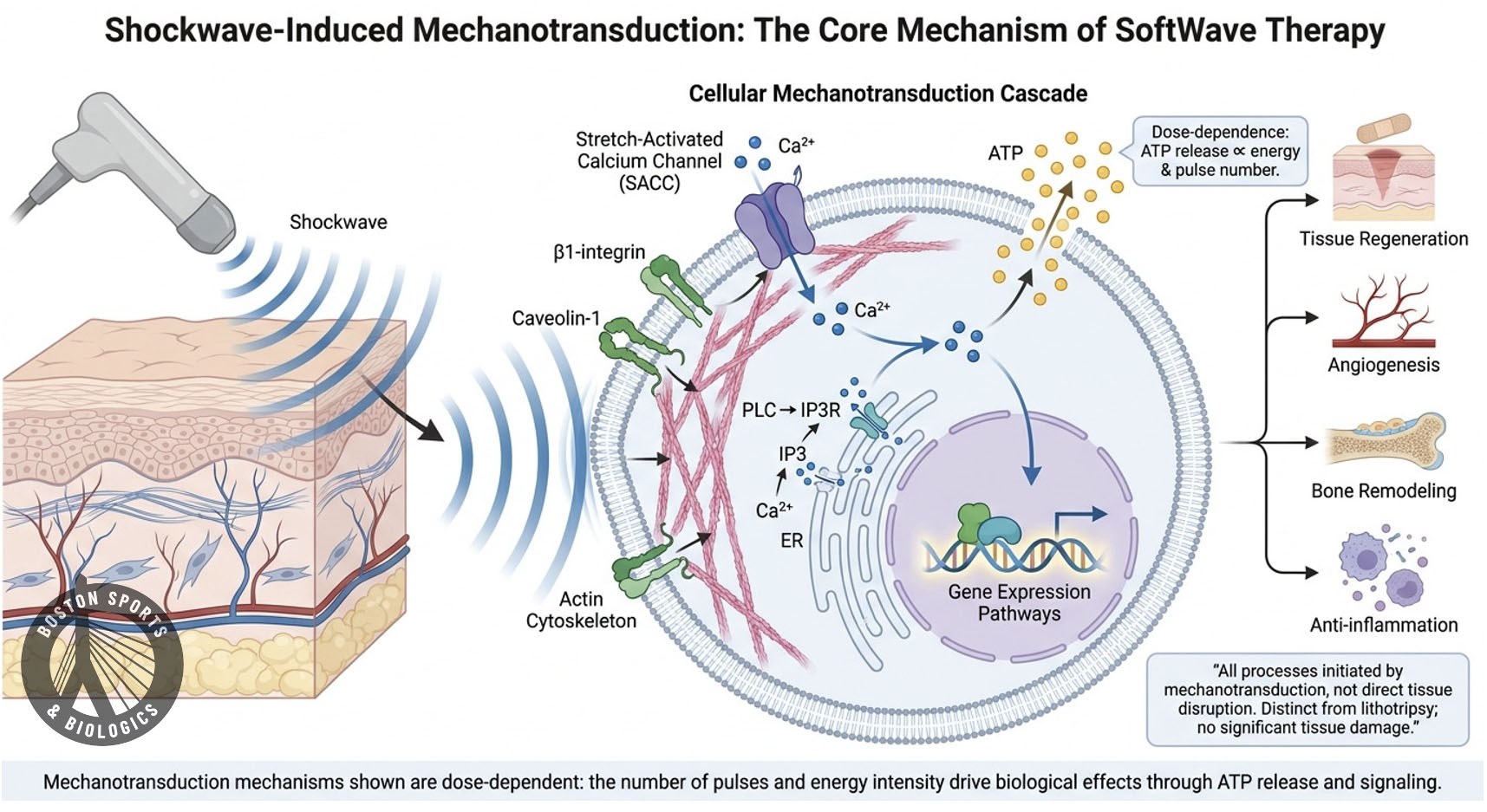
These signals ultimately drive healing. These mechanotransduction mechanisms explain how shockwave therapy promotes tissue healing without causing significant tissue damage. The biological effects are dose-dependent, with energy levels and pulse numbers determining the magnitude of ATP release and subsequent cellular responses.
The biological responses described—stem cell activation, growth factor release (VEGF, TGF-β, IGF-1), and collagen production—are well-supported by peer-reviewed research as key regenerative effects of shockwave therapy (d'Agostino et al, 2015; Vetrano et al, 2011; Russo et al, 2015; Chen et al, 2004; Kou et al, 2024).
Shockwaves create rapid pressure spikes followed by negative pressure, producing:
This initiates the healing cascade.
The mechanical stimulus causes cells to release ATP and signaling molecules, activating pathways like:
These pathways regulate:
This leads to several key regenerative effects:
Shockwave therapy recruits and activates local progenitor cells, enhancing tissue repair.
Increased expression of:
Stimulates Type I collagen synthesis, critical for tendon healing.
The advantage of SoftWave’s broader energy field is that it:
In real-world musculoskeletal conditions, pain is rarely isolated to a single structure—this matters clinically.
No—and this is a major misconception.
While early shockwave use focused on breaking calcifications, modern SoftWave therapy is about:
Cellular signaling and regeneration—not destruction
In fact, most of its benefits come from biological stimulation, not mechanical disruption.
Unlike injections, results are progressive, reflecting true tissue healing.
SoftWave therapy represents a shift in how we treat musculoskeletal injuries.
Instead of suppressing symptoms, it:
By leveraging broadly focused shockwave technology, SoftWave provides a powerful, non-invasive solution for patients seeking long-term recovery, not temporary relief.
It’s a more advanced version using broadly focused energy for deeper and more comprehensive treatment.
Most patients tolerate it well. Mild discomfort can occur but is brief.
Many patients notice improvement within weeks, with continued healing over time.
Coverage varies. Many regenerative treatments are currently self-pay, but Medicare does now cover shockwave.
Basoli V, Chaudary S, Cruciani S, Santaniello S, Balzano F, Ventura C, Redl H, Dungel P, Maioli M. Mechanical Stimulation of Fibroblasts by Extracorporeal Shock Waves: Modulation of Cell Activation and Proliferation Through a Transient Proinflammatory Milieu. Cell Transplant. 2020 Jan-Dec;29:963689720916175. doi: 10.1177/0963689720916175. PMID: 32326741; PMCID:PMC7586264.
Cathignol D, Mestas JL, Gomez F, Lenz P. Influence of water conductivity on the efficiency and the reproducibility of electrohydraulic shock wave generation. Ultrasound Med Biol. 1991;17(8):819-28. doi: 10.1016/0301-5629(91)90165-s. PMID: 1808800.
Cheng JH, Wang CJ. Biological mechanism of shockwave in bone. Int J Surg. 2015 Dec;24(Pt B):143-6. doi: 10.1016/j.ijsu.2015.06.059. Epub 2015 Jun 25. PMID: 26118613.
Chen YJ, Wurtz T, Wang CJ, Kuo YR, Yang KD, Huang HC, Wang FS.
Recruitment of mesenchymal stem cells and expression of TGF-beta 1 and VEGF in the early stage of shock wave-promoted bone regeneration of segmental defect in rats. J Orthop Res. 2004 May;22(3):526-34. doi: 10.1016/j.orthres.2003.10.005. PMID: 15099631.
d'Agostino MC, Craig K, Tibalt E, Respizzi S. Shock wave as biological therapeutic tool: From mechanical stimulation to recovery and healing, through mechanotransduction. Int J Surg. 2015 Dec;24(Pt B):147-53. doi: 10.1016/j.ijsu.2015.11.030. Epub 2015 Nov 28. PMID: 26612525.
Hatanaka K, Ito K, Shindo T, Kagaya Y, Ogata T, Eguchi K, Kurosawa R, Shimokawa H. Molecular mechanisms of the angiogenic effects of low-energy shock wave therapy: roles of mechanotransduction. Am J Physiol Cell Physiol. 2016 Sep 1;311(3):C378-85. doi: 10.1152/ajpcell.00152.2016. Epub 2016 Jul 13. PMID: 27413171.
Holfeld J, Tepeköylü C, Reissig C, Lobenwein D, Scheller B, Kirchmair E, Kozaryn R, Albrecht-Schgoer K, Krapf C, Zins K, Urbschat A, Zacharowski K, Grimm M, Kirchmair R, Paulus P. Toll-like receptor 3 signalling mediates angiogenic response upon shock wave treatment of ischaemic muscle. Cardiovasc Res. 2016 Feb 1;109(2):331-43. doi: 10.1093/cvr/cvv272. Epub 2015 Dec 16. PMID: 26676850.
Kou D, Chen Q, Wang Y, Xu G, Lei M, Tang X, Ni H, Zhang F. The application of extracorporeal shock wave therapy on stem cells therapy to treat various diseases. Stem Cell Res Ther. 2024 Aug 26;15(1):271. doi: 10.1186/s13287-024-03888-w. PMID: 39183302;PMCID: PMC11346138.
Mittermayr R, Haffner N, Feichtinger X, Schaden W. The role of shockwaves in the enhancement of bone repair - from basic principles to clinical application. Injury. 2021 Jun;52 Suppl 2:S84-S90. doi: 10.1016/j.injury.2021.02.081. Epub 2021 Mar 2. PMID: 33714550.
Rosso F, Bonasia DE, Marmotti A, Cottino U, Rossi R. Mechanical
Stimulation (Pulsed Electromagnetic Fields "PEMF" and Extracorporeal Shock Wave Therapy "ESWT") and Tendon Regeneration: A Possible Alternative. Front Aging Neurosci. 2015 Nov 9;7:211. doi: 10.3389/fnagi.2015.00211. PMID: 26617513; PMCID: PMC4637423.
Sun D, Junger WG, Yuan C, Zhang W, Bao Y, Qin D, Wang C, Tan L, Qi B, Zhu D, Zhang X, Yu T. Shockwaves induce osteogenic differentiation of human mesenchymal stem cells through ATP release and activation of P2X7 receptors. Stem Cells. 2013 Jun;31(6):1170-80. doi: 10.1002/stem.1356. PMID: 23404811; PMCID: PMC4243484.
Szwarc-Hofbauer D, Simböck E, Hromada C, Stoiber M, Tomasch J, Weitzer G, Teuschl-Woller A. Purinergic receptors play a key role in shock wave-induced proliferation. Sci Rep. 2025 May 31;15(1):19138. doi: 10.1038/s41598-025-02955-3. PMID:40450090; PMCID: PMC12126489.
Takahashi T, Nakagawa K, Tada S, Tsukamoto A. Low-energy shock waves evoke intracellular Ca2+ increases independently of sonoporation. Sci Rep. 2019 Mar 1;9(1):3218. doi: 10.1038/s41598-019-39806-x. PMID: 30824781; PMCID: PMC6397190.
Thiel M. Application of shock waves in medicine. Clin Orthop Relat Res. 2001 Jun;(387):18-21. doi: 10.1097/00003086-200106000-00004. PMID: 11400881.
Vetrano M, d'Alessandro F, Torrisi MR, Ferretti A, Vulpiani MC, Visco V. Extracorporeal shock wave therapy promotes cell proliferation and collagen synthesis of primary cultured human tenocytes. Knee Surg Sports Traumatol Arthrosc. 2011 Dec;19(12):2159-68. doi: 10.1007/s00167-011-1534-9. Epub 2011 May 27. PMID: 21617986.
Weihs AM, Fuchs C, Teuschl AH, Hartinger J, Slezak P, Mittermayr R, Redl H, Junger WG, Sitte HH, Rünzler D. Shock wave treatment enhances cell proliferation and improves wound healing by ATP release-coupled extracellular signal-regulated kinase (ERK) activation. J Biol Chem. 2014 Sep 26;289(39):27090-27104. doi: 10.1074/jbc.M114.580936. Epub 2014 Aug 12. PMID: 25118288; PMCID: PMC4175346.
Yu T, Junger WG, Yuan C, Jin A, Zhao Y, Zheng X, Zeng Y, Liu J.
Shockwaves increase T-cell proliferation and IL-2 expression through ATP release, P2X7 receptors, and FAK activation. Am J Physiol Cell Physiol. 2010 Mar;298(3):C457-64. doi: 10.1152/ajpcell.00342.2009. Epub 2009 Nov 4. PMID: 19889958; PMCID: PMC4631534.
How safe are PRP injections for knee arthritis? A recent study found that PRP has similar side effects to hyaluronic acid and steroid injections, with temporary post-injection pain being the most common reaction.
Read MoreKnee arthritis isn't just about cartilage. Bone marrow lesions in the bone beneath the cartilage may contribute to pain with walking, standing, and stairs. Learn what these MRI findings mean and why their location
Read More