Email: info@BSBortho.com

Vaccines save millions of lives every year. But many people notice shoulder pain after a vaccine, especially after flu shots or COVID-19 vaccines.
In most cases, this discomfort is normal and temporary. The immune response triggered by vaccination often causes soreness in the muscle where the injection was given.
However, sometimes shoulder pain after vaccination can persist longer than expected. When this happens, it may represent a condition known as Shoulder Injury Related to Vaccine Administration (SIRVA).
Understanding the difference between normal vaccine soreness and a possible shoulder injury can help determine whether medical evaluation is needed.
Mild shoulder soreness is one of the most common side effects of vaccines, affecting 53-83% of vaccine recipients, and typically resolves within 1-2 days (Baden et al, 2021). This occurs because the immune system is responding to the vaccine and creating protective antibodies.
Typical features of normal vaccine-related soreness include:
• Pain starting within a few hours after the injection
• Mild tenderness around the injection site
• Pain that improves within 24–48 hours
• Ability to move the shoulder normally
These symptoms are expected and most symptoms resolve completely within 2 days, with over 80% of all vaccine-related symptoms resolving in this timeframe (Ebinger et al, 2021).
In fact, mild shoulder discomfort after vaccination is very common and self-limited.
Simple treatments can help:
Ice packs
Gentle shoulder movement
Over-the-counter anti-inflammatory medications
For most people, symptoms disappear within a couple of days. Importantly, these symptoms do not require medical evaluation and represent expected vaccine reactogenicity rather than injury.
Occasionally, shoulder pain persists longer than expected. In these cases, the problem may not be muscle soreness but rather an injury to deeper shoulder structures.
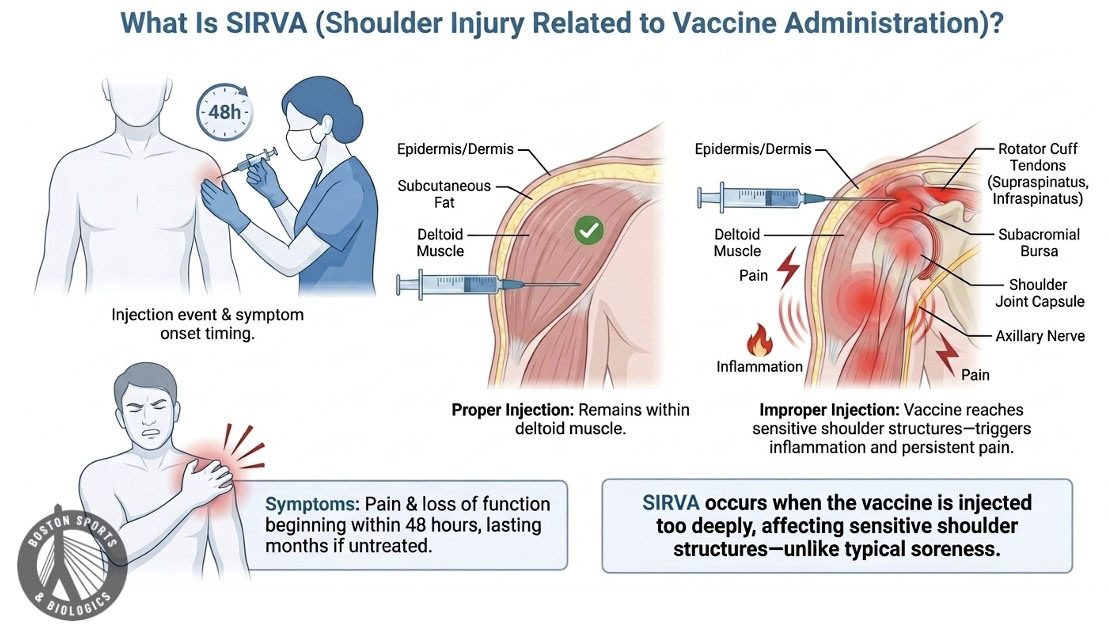
A condition called Shoulder Injury Related to Vaccine Administration (SIRVA) can occur when a vaccine is injected too high or too deep into the shoulder.
Signs that shoulder pain after a vaccine may be abnormal include:
Pain lasting longer than 3–7 days
Pain that is worsening rather than improving
Significant loss of shoulder motion
Pain with lifting the arm
Weakness in the shoulder
Night pain
In these situations, evaluation by a physician may be helpful. The key distinction is that normal vaccine soreness is mild, self-limited, and improves steadily, whereas SIRVA involves severe pain, functional limitation, and persistence beyond one week.
Patients should seek evaluation if they experience severe pain limiting daily activities, inability to raise the arm or perform normal movements, pain persisting beyond 7 days, or progressive worsening of symptoms rather than improvement (Janssen et al, 2023; Bass & Poland, 2022).
SIRVA refers to persistent shoulder pain and dysfunction that begins shortly after vaccination (Bass & Poland, 2022).
Symptoms typically begin within 48 hours of the injection and may last months if untreated.
Unlike typical vaccine soreness, SIRVA occurs when the injection affects structures deeper than the deltoid muscle.
Possible affected structures include:
Rotator cuff tendons
Subacromial bursa
Shoulder capsule
Axillary nerve
When the vaccine enters these structures, it can trigger inflammation and pain.
SIRVA is uncommon. The most rigorous population-based study found an incidence of 9.9 per 100,000 vaccinations (99 per million) among all ages, and 12.2 per 100,000 (122 per million) in adults aged 18 years and older (Zheng et al, 2022).
A 2025 analysis of the European pharmacovigilance database examining over 1.17 billion COVID-19 vaccines found 37 cases per million vaccinations (3.7 per 100,000). [2] This study noted the incidence was "higher than previously reported" and varied by vaccine formulation (Mackenzie et al, 2025).
While SIRVA remains relatively uncommon compared to the hundreds of millions of vaccines administered annually, the best population-based evidence suggests rates closer to 10-40 per 100,000 vaccinations (100-400 per million) in adults
Several shoulder conditions may occur after an improperly placed injection.
Subacromial bursitis: The subacromial bursa is a fluid-filled sac that reduces friction in the shoulder.
If vaccine fluid enters this space, it may cause:
Severe shoulder pain
Pain with overhead movement
Limited range of motion
Rotator cuff inflammation: The rotator cuff tendons stabilize the shoulder joint. Injection near these tendons may cause:
Tendinitis
Partial tendon injury
Pain lifting the arm
Frozen shoulder (adhesive capsulitis): In some cases, inflammation can lead to stiffness and progressive loss of motion known as frozen shoulder.
Nerve irritation: Rarely, irritation of the axillary nerve may cause numbness, tingling, or weakness in the arm.
SIRVA is usually related to injection technique rather than the vaccine itself (Bass & Poland, 2022; Yuen et al,2022). Anatomically, the shoulder contains multiple structures just beneath the deltoid muscle, including bursae, tendons, and nerves.
The literature emphasizes that while there may be an immune mediated component, the primary cause is improper administration technique. Injection into or near the subdeltoid bursa or shoulder joint rather than the deltoid muscle may cause inflammation and injury.
Risk factors include (Martin Arias et al, 2017; Zheng et al, 2022):
Injection too high on the shoulder: Studies recommend injection sites 4-6 cm below the acromion to avoid
shoulder structures. Injections that are "more anterior and superior"
are associated with overpenetration and increased risk.
Improper needle length: Needle length must be matched to patient body habitus. Studies show that
a 1-inch needle reaches the deltoid in only 85.3% of women <200 lbs
and may fail in obese patients. Conversely, 1.5-inch needles cause
overpenetration in lighter patients.
Patient characteristics: Female sex (71-76% of SIRVA cases), lower BMI (median 23.5 kg/m²), and advanced age are associated with higher risk.
Incorrect arm positioning during injection: While not extensively detailed in these sources, proper positioning is mentioned as part of appropriate technique.
When shoulder pain persists after vaccination, physicians begin with a detailed history and evaluation. The hallmark presentation is severe shoulder pain and limited range of motion within 48 hours of vaccination in patients with no prior shoulder dysfunction. [2-4]
Studies confirm that 97.7% of patients report pain and 68.1% report limited range of motion as primary symptoms (Bass & Poland, 2022). Physical examination reveals limited glenohumeral ROM, limitations in activities of daily living, and injection site pain (Janssen et al, 2023).
Key factors include:
Timing of symptoms after vaccination
Location of the injection
Prior shoulder problems
Physical examination findings
Imaging studies may help confirm the diagnosis.
Yes. SIRVA is largely preventable with proper injection technique.
Best practices include:
Selecting proper needle length: Match needle length to patient body habitus. A 1-inch needle reaches the deltoid in only 85.3% of women <200 lbs, while 1.5-inch needles may over penetrate in lighter patients (Sebro et al, 2022; Mardourian et al, 2023).
Increased awareness among healthcare providers has already helped reduce risk.
Most vaccine-related soreness improves quickly.
You should consider medical evaluation if:
Pain lasts longer than one week
Shoulder motion becomes limited
Pain interferes with sleep
Weakness develops
Symptoms worsen instead of improving
Early evaluation can help identify conditions like bursitis, tendon injury, or frozen shoulder.
Most vaccine soreness resolves within 24–48 hours. Pain lasting more than 5–7 days may warrant evaluation.
Yes. Mild soreness is very common. However, persistent shoulder pain is rare.
SIRVA stands for Shoulder Injury Related to Vaccine Administration, a condition where improper injection placement causes inflammation in deeper shoulder structures.
Some cases improve with rest and therapy. Others require medical treatment such as injections or guided procedures.
No. Vaccines remain very safe and essential for preventing disease. SIRVA is rare and largely preventable with proper technique.
Martín Arias LH, Sanz Fadrique R, Sáinz Gil M, Salgueiro-Vazquez ME. Risk of bursitis and other injuries and
dysfunctions of the shoulder following vaccinations. Vaccine. 2017 Sep 5;35(37):4870-4876. doi: 10.1016/j.vaccine.2017.07.055. Epub 2017 Jul 31. PMID: 28774564.
Baden LR, El Sahly HM, Essink B, Kotloff K, Frey S, Novak R, Diemert D, Spector SA, Rouphael N, Creech CB, McGettigan J, Khetan S, Segall N, Solis J, Brosz A, Fierro C, Schwartz H, Neuzil K, Corey L, Gilbert P, Janes H, Follmann D, Marovich M, Mascola J, Polakowski L, Ledgerwood J, Graham BS, Bennett H, Pajon R, Knightly C, Leav B, Deng W, Zhou H, Han S, Ivarsson M, Miller J, Zaks T; COVE Study Group. Efficacy and Safety of the mRNA-1273 SARS-CoV-2 Vaccine. N Engl J Med. 2021 Feb 4;384(5):403-416. doi: 10.1056/NEJMoa2035389. Epub 2020 Dec 30. PMID: 33378609; PMCID: bvnmPMC7787219.
Bass JR, Poland GA. Shoulder injury related to vaccine administration (SIRVA) after COVID-19 vaccination. Vaccine. 2022 Aug 12;40(34):4964-4971. doi: 10.1016 j.vaccine.2022.06.002. Epub 2022 Jun 8. PMID: 35817645; PMCID: PMC9174179.
Ebinger JE, Lan R, Sun N, Wu M, Joung S, Botwin GJ, Botting P, Al-Amili D, Aronow H, Beekley J, Coleman B, Contreras S, Cozen W, Davis J, Debbas P, Diaz J, Driver M, Fert-Bober J, Gu Q, Heath M, Herrera E, Hoang A, Hussain SK, Huynh C, Kim L, Kittleson M, Liu Y, Lloyd J, Luong E, Malladi B, Merchant A, Merin N, Mujukian A, Nguyen N, Nguyen TT, Pozdnyakova V, Rashid M, Raedschelders K, Reckamp KL, Rhoades K, Sternbach S, Vallejo R, White S, Tompkins R, Wong M, Arditi M, Figueiredo JC, Van Eyk JE, Miles PB, Chavira C, Shane R, Sobhani K, Melmed GY, McGovern DPB, Braun JG, Cheng S, Minissian MB. Symptomology following mRNA vaccination against SARS-CoV-2. Prev Med. 2021 Dec;153:106860. doi: 10.1016/j.ypmed.2021.106860. Epub 2021 Oct 20. PMID: 34687733; PMCID: PMC8527734.
Janssen ERC, van Montfoort AZ, Hollman F, Lambers Heerspink FO. The prevalence and clinical course of shoulder injury related to vaccine administration (SIRVA) after COVID-19 vaccines in Dutch hospital workers. Vaccine. 2023 Sep 22;41(41):6042-6047. doi: 10.1016/j.vaccine.2023.08.043. Epub 2023 Aug 25. PMID: 37635003.
Kim YG, Chung YH, Ahn HJ, Jeon A, Kim YS, Hwang K, Han SH. Thickness of the Deltoid Muscle and Location of the Anterior Branch of the Axillary Nerve and the Posterior Circumflex Humeral Artery for Deltoid Injections. Biomed Res Int. 2022 Dec 15;2022:1784572. doi: 10.1155/2022/1784572. PMID: 36567904; PMCID: PMC9779993.
Mackenzie LJ, Bousie JA, Newman P, Cunningham J, Woodward AP, Silk-Jones J, Nguyen C, Bushell MA. What three years of COVID-19 vaccine administration reveals about the incidence of shoulder injury related to vaccine administration (SIRVA). Vaccine. 2025 Apr 2;51:126892. doi: 10.1016 j.vaccine.2025.126892. Epub 2025 Feb 20. PMID: 39983541.
Mardourian M, Hao KA, Wiggins W, Arias J, King JJ, Wright TW, Wright JO. Optimizing needle length and site choice for adult immunization. Vaccine. 2023 Jul 25;41(33):4836-4843. doi: 10.1016/j.vaccine.2023.06.031. Epub 2023 Jun 24. PMID: 37365058.
Nakajima Y, Mukai K, Takaoka K, Hirose T, Morishita K, Yamamoto T, Yoshida Y, Urai T, Nakatani T. Establishing a new appropriate intramuscular injection site in the deltoid muscle. Hum Vaccin Immunother. 2017 Sep 2;13(9):2123-2129. doi: 10.1080/21645515.2017.1334747. Epub 2017 Jun 12. PMID: 28604191; PMCID: PMC5612213.
Sebro R. Statistical estimation of deltoid subcutaneous fat pad thickness: implications for needle length for vaccination. Sci Rep. 2022 Jan 20;12(1):1069. doi: 10.1038/s41598-022-05020-5. PMID: 35058499; PMCID: PMC8776900.
Yuen WLP, Loh SYJ, Wang DB. SIRVA (Shoulder Injury Related to Vaccine Administration) following mRNA COVID-19 Vaccination: Case discussion and literature review. Vaccine. 2022 Apr 20;40(18):2546-2550. doi: 10.1016/j.vaccine.2022.03.037. Epub 2022 Mar 21. PMID: 35339304; PMCID: PMC8934720.
Zheng C, Duffy J, Liu IA, Sy LS, Chen W, Qian L, Navarro RA, Ryan DS, Kim SS, Mercado C, Jacobsen SJ. Risk for Shoulder Conditions After Vaccination: A Population-Based Study Using Real-World Data. Ann Intern Med. 2022 May;175(5):634-643. doi: 10.7326/M21-3023. Epub 2022 Mar 22. PMID: 35313110; PMCID: PMC9117507.
How safe are PRP injections for knee arthritis? A recent study found that PRP has similar side effects to hyaluronic acid and steroid injections, with temporary post-injection pain being the most common reaction.
Read MoreKnee arthritis isn't just about cartilage. Bone marrow lesions in the bone beneath the cartilage may contribute to pain with walking, standing, and stairs. Learn what these MRI findings mean and why their location
Read More